When you first open the system, it greets you with a clean, intuitive interface where marketing is not just one disconnected app, but a whole ecosystem. Everything is here:
Website —the foundation for attracting customers: from organic search to advertising campaigns, with built-in SEO.
CRM and Sales — for instant lead capture and managing deals through the funnel.
Email marketing — newsletters, templates, A/B testing, open rates, and click-through statistics.
SMS marketing — short messages about promotions, order confirmations, or reminders — is a channel that opens almost immediately, unlike email.
Social media marketing — content calendar and post planning for multiple platforms from one window, with analytics on which content performs better.
Marketing automation— workflow scenarios that automatically guide the lead through a chain of emails.
Surveys — feedback forms, NPS, satisfaction tests — results are collected and analyzed automatically, without manual aggregation.
Events — event pages, registration, ticket sales, automatic reminders for webinar or exhibition participants.
Knowledge — the base of instructions and scripts for the team in the same window.
eCommerce — tracking abandoned carts and customer behavior for personalized campaigns.
Analytics and Dashboards — UTM tags, campaign ROI, channel funnel, real-time KPIs.
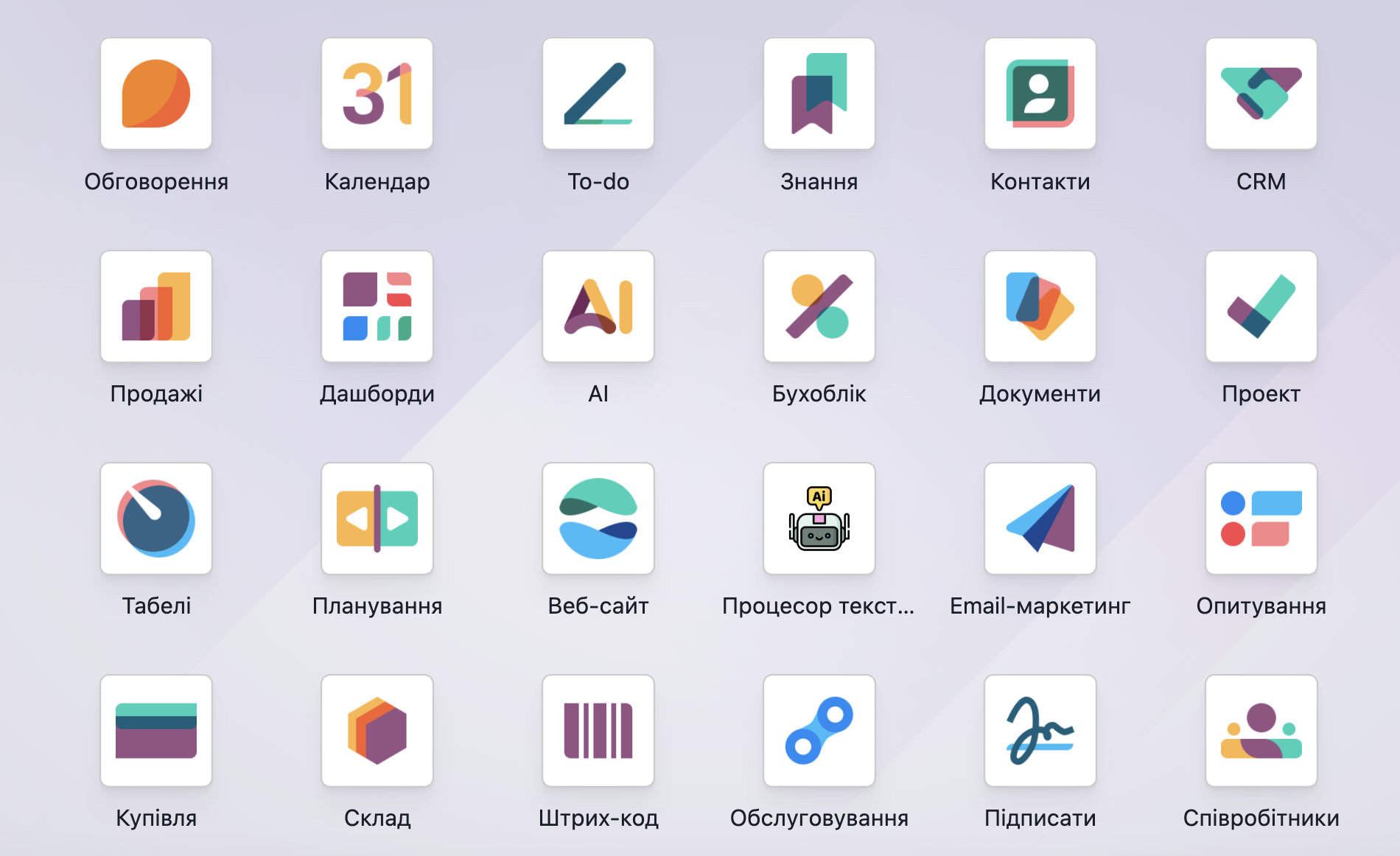
All of this is gathered in one window, like apps on a smartphone screen.
My former nightmare: switching between 10 tabs, manually compiling analytics from Meta or Google Ads into Excel, and arguing with the sales department every Monday about whose numbers are correct. Odoo completely eliminated this routine.
But today I won’t get sidetracked by all the modules of the system. I will show you what I like the most.
1. A website that sells
It all started with our corporate website UBM SOFT based on Odoo Website. We launched it to test the system we offer to clients based on our own experience.
And here’s what turned out to be the main marketing bonus: everything is set up incredibly simply, intuitively, and stylishly.
Visual block builder: Page design is assembled like a constructor right on the screen. Need to add a form, banner, or new block? Just drag it with your mouse from the menu panel.
Built-in SEO "out of the box": Just open the "Optimize SEO" tab — and the system automatically shows a preview window of the page in Google search results. Odoo automatically generates sitemap.xml, optimizes image weights, and analyzes keywords, offering suggestions based on real user search queries.
Complete marketing autonomy: Blog posts, new pages, menu editing, or launching lead forms — everything is done with one click.
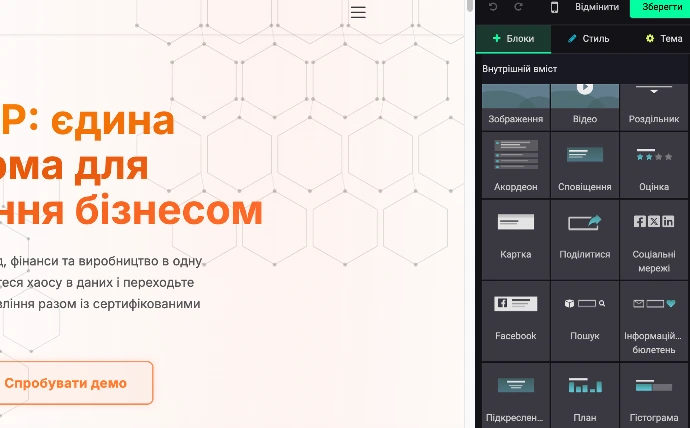
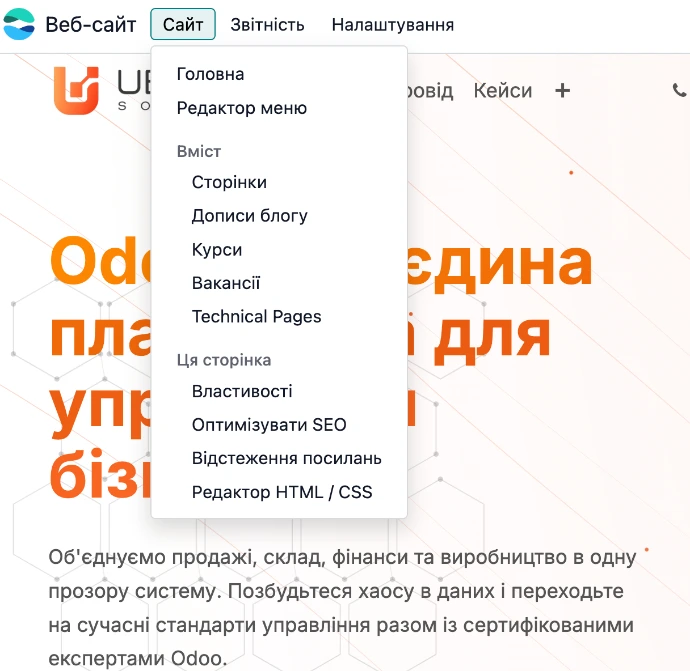
Result: thanks to the proper structure and clean code, Google's system instantly picks up our updates and rewards us with rankings in the search results.
2. From ad click to customer card
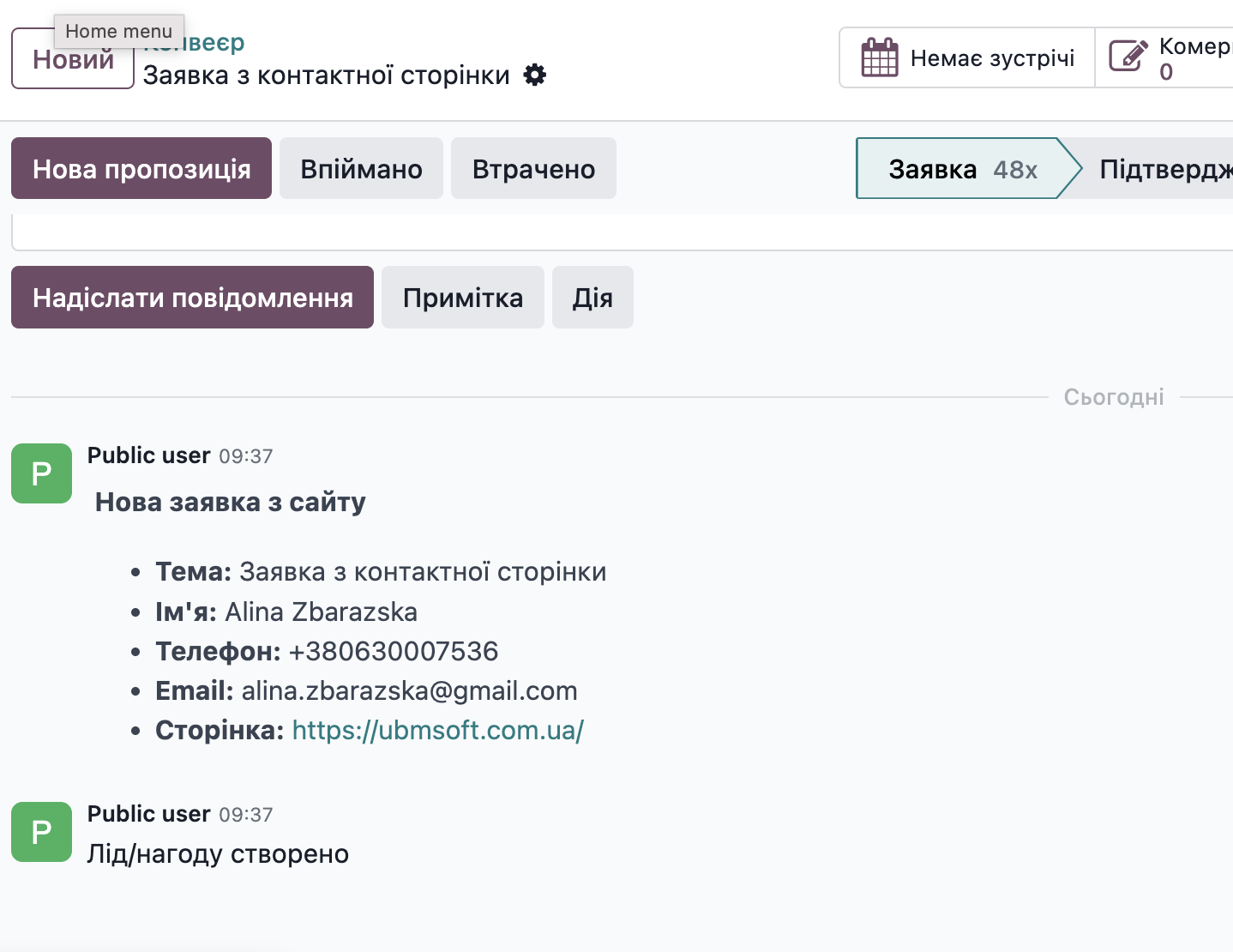
Here is our conveyor today, as it looks from inside the system: the client fills out a form on the website — and Odoo instantly, without any delay, creates a card in the CRM at the first stage "Application."
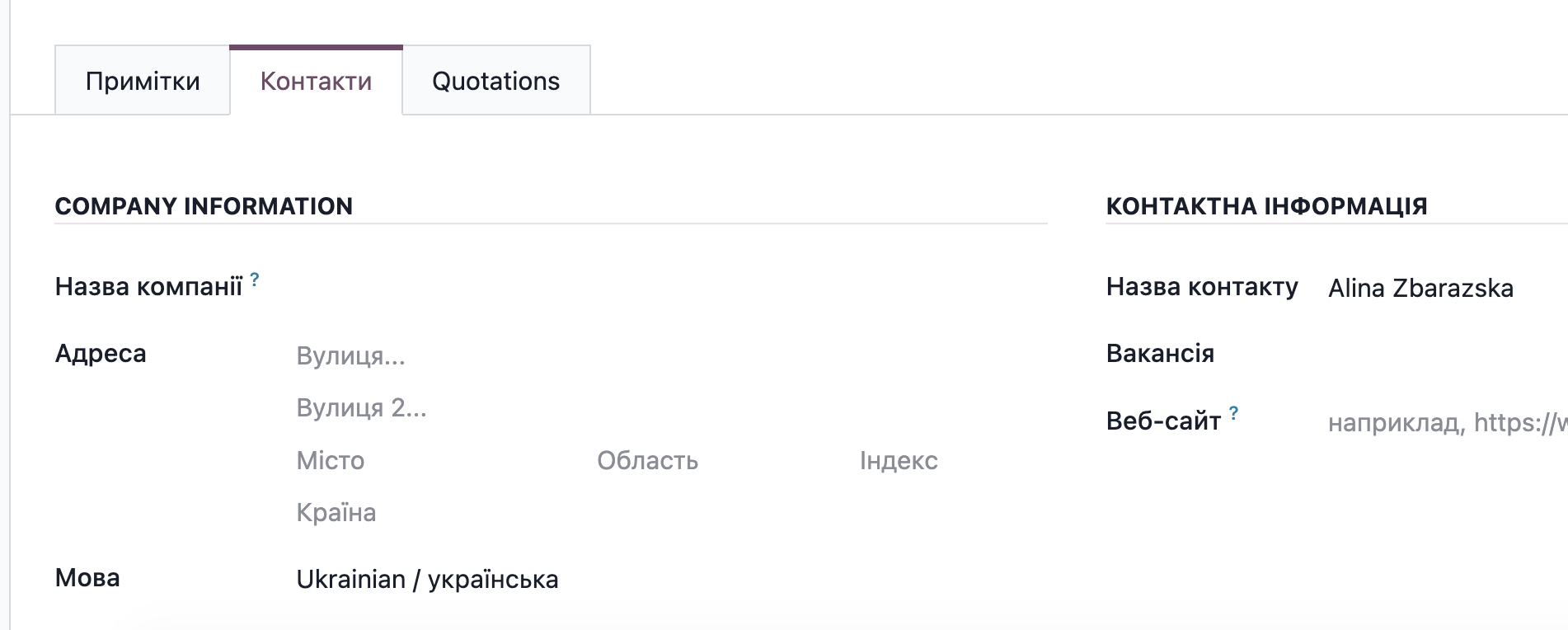
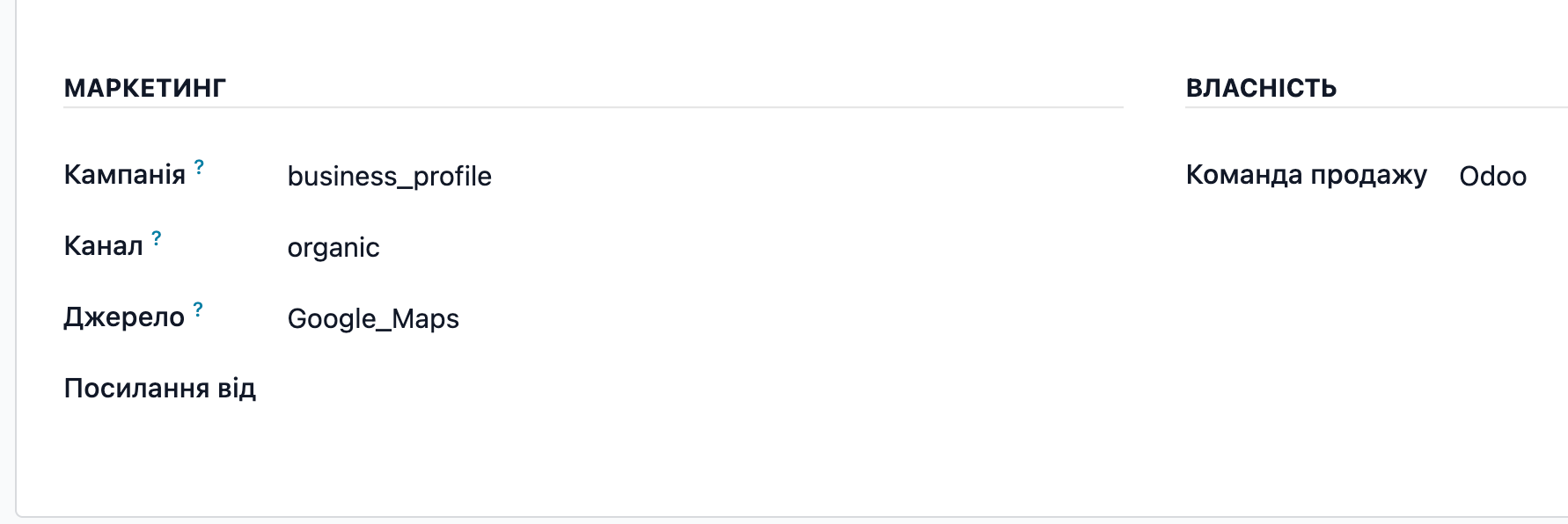
And the first thing I see as a marketer in this card is not just the bare conversion of "form filled out," but where the client actually came from: the campaign, channel, and source are automatically recorded in the "Contacts" tab. No more guessing whether it's the same Google / CPC that we optimized last week or a random organic visit.
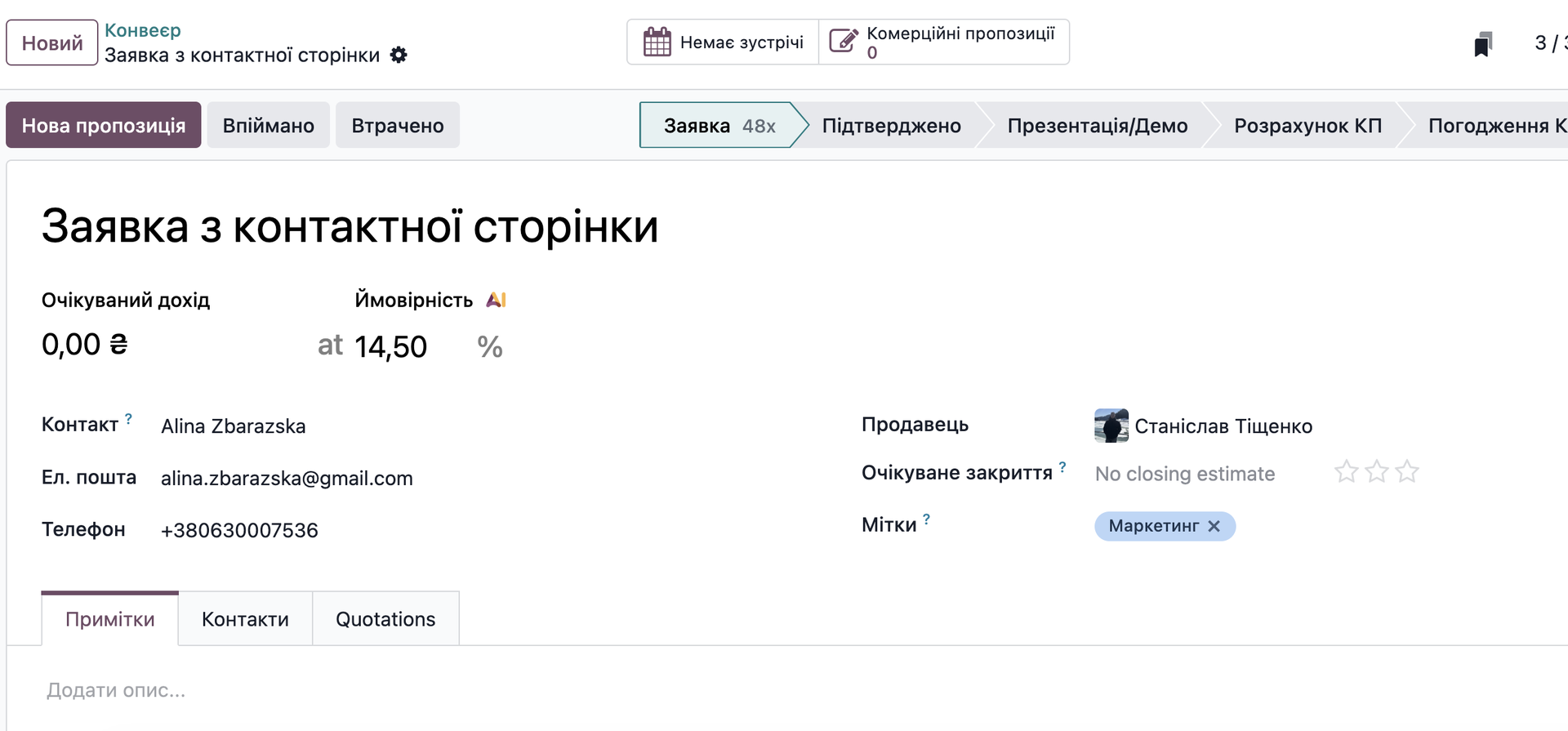
Next, the lead follows its path through the sales funnel:
Application ➡️ Confirmed ➡️ Presentation/Demo ➡️ Cost Calculation ➡️ Cost Agreement ➡️ Contract Signing ➡️ In Progress.
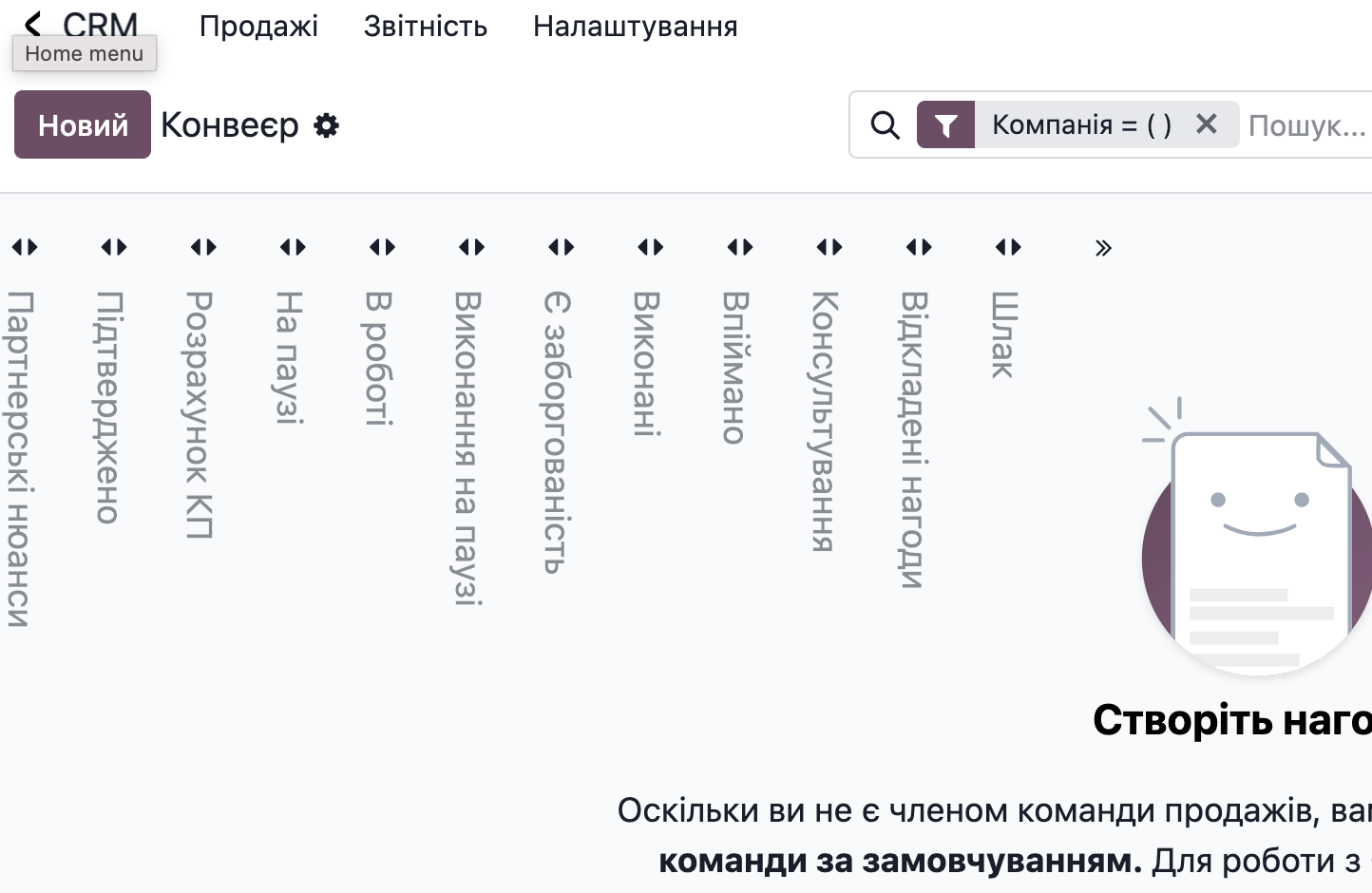
The manager sees not just a bare name, but a complete card with all the contacts, automatic call transcriptions, and reminders for the next step — and that’s why no lead generated by marketing gets lost along the way.
The main value for me as a marketer: I see not only how many leads came in, but also what happened to them next — from the first click on the ad to the status of the deal right now.
3. One dashboard instead of dozens of tabs
When a lead is closed for payment, Odoo automatically pulls in financial metrics and end-to-end analytics in real time. I open the main analytics screen and immediately see the key KPIs of the company:
Revenue: total revenue of the company for the analyzed period.
Lead dynamics: the graph clearly shows how we smoothly rose from a plateau of 10–20 leads per month to a stable conveyor of over 60 quality inquiries.
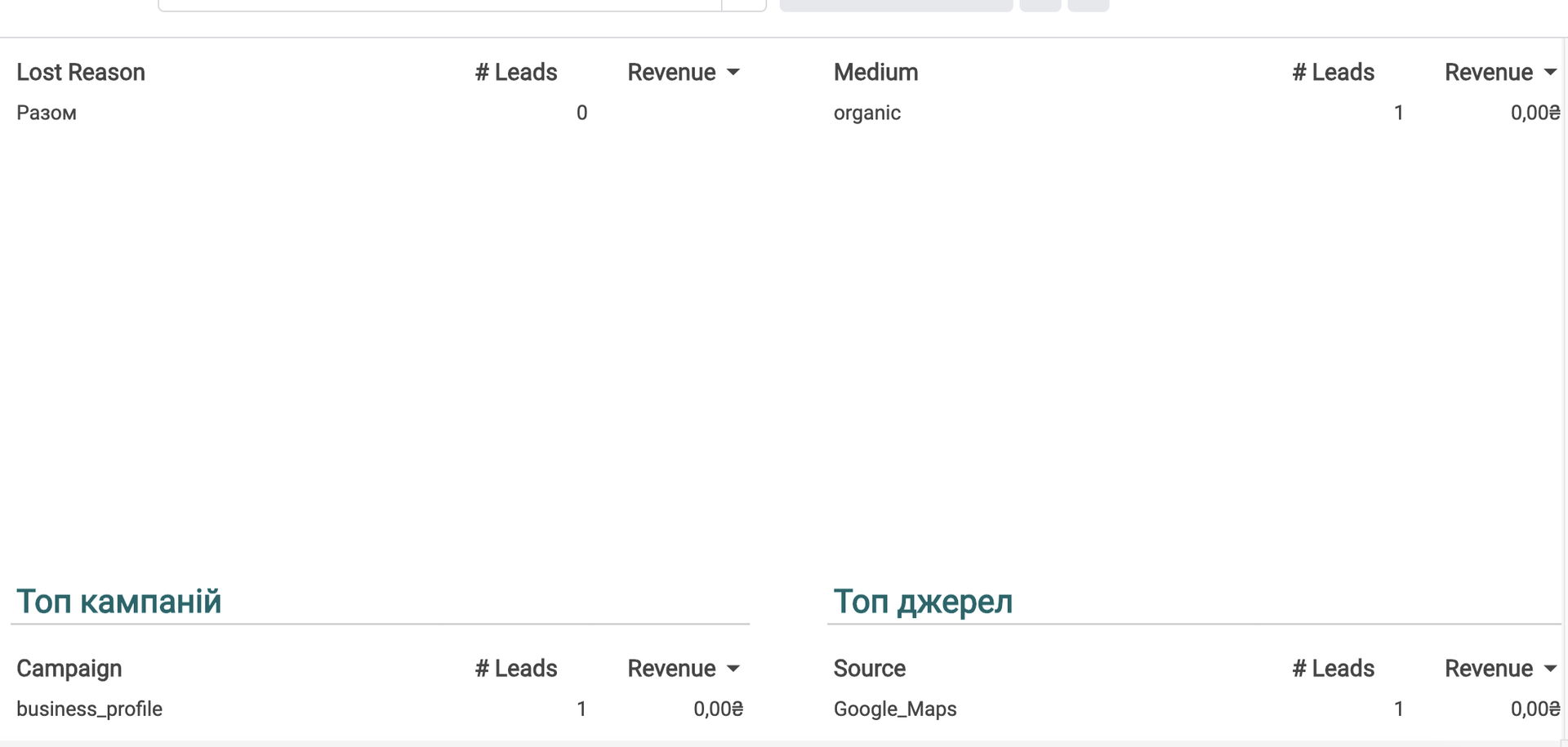
Top campaigns: every penny is automatically linked to advertising activity, so I can clearly see which campaign is the leader.
Top sources: the Google search engine brings in the lion's share of traffic, but the system clearly records transitions from TikTok or ChatGPT as separate lines.
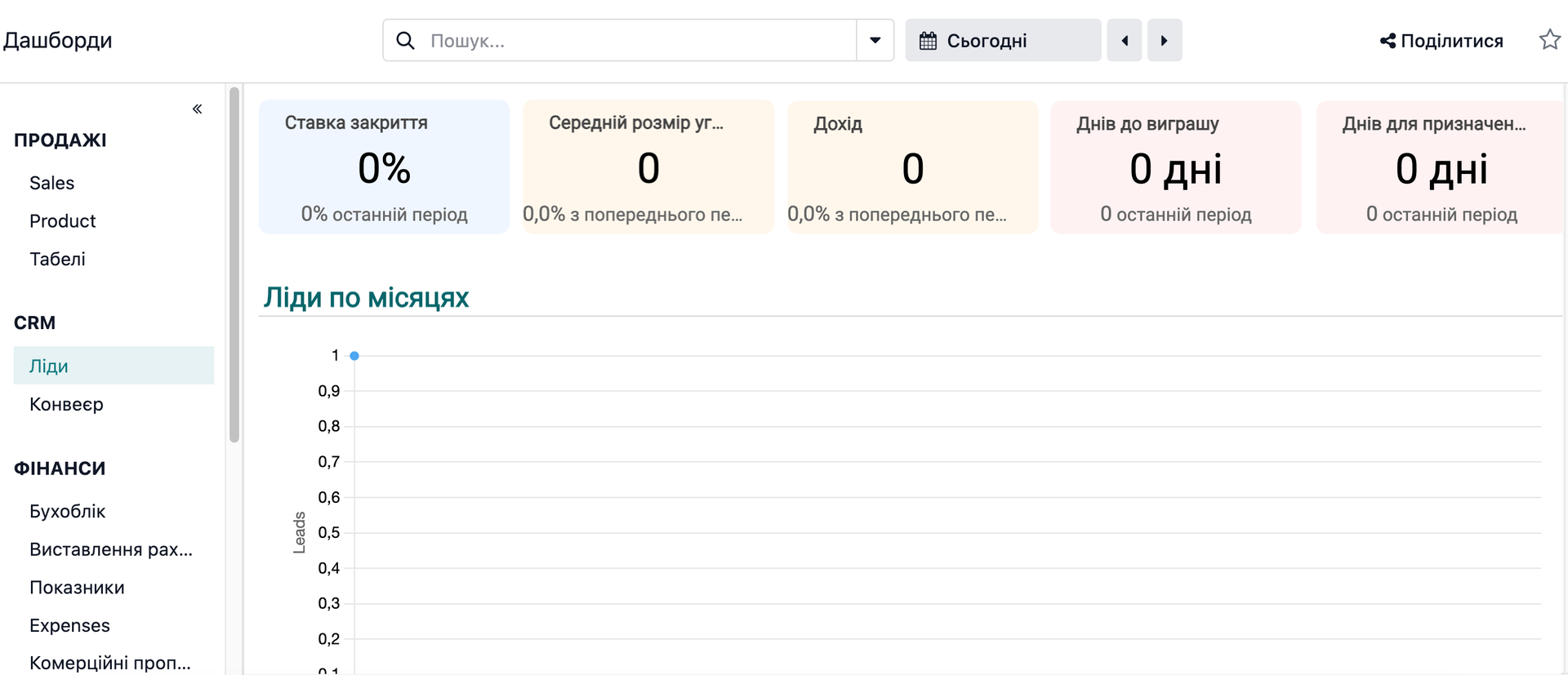
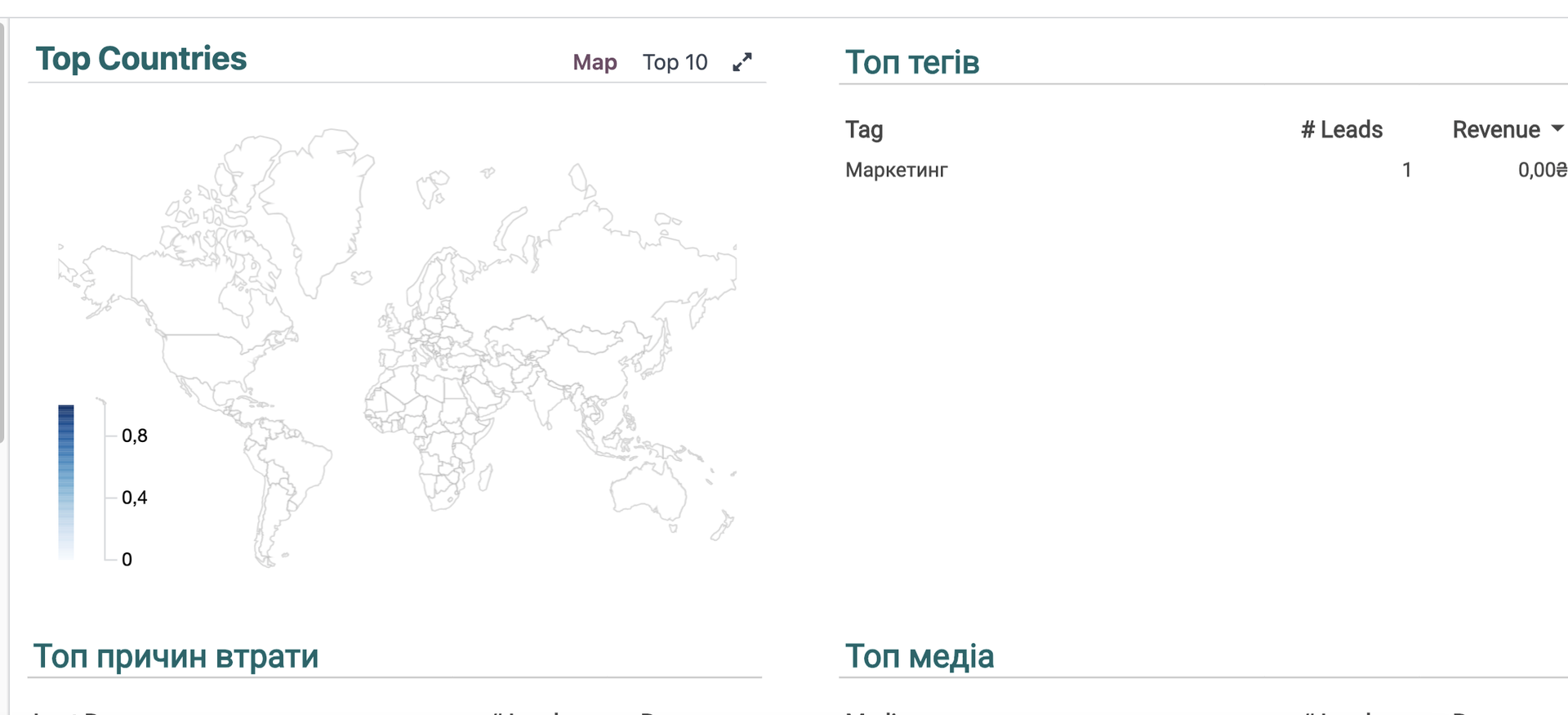
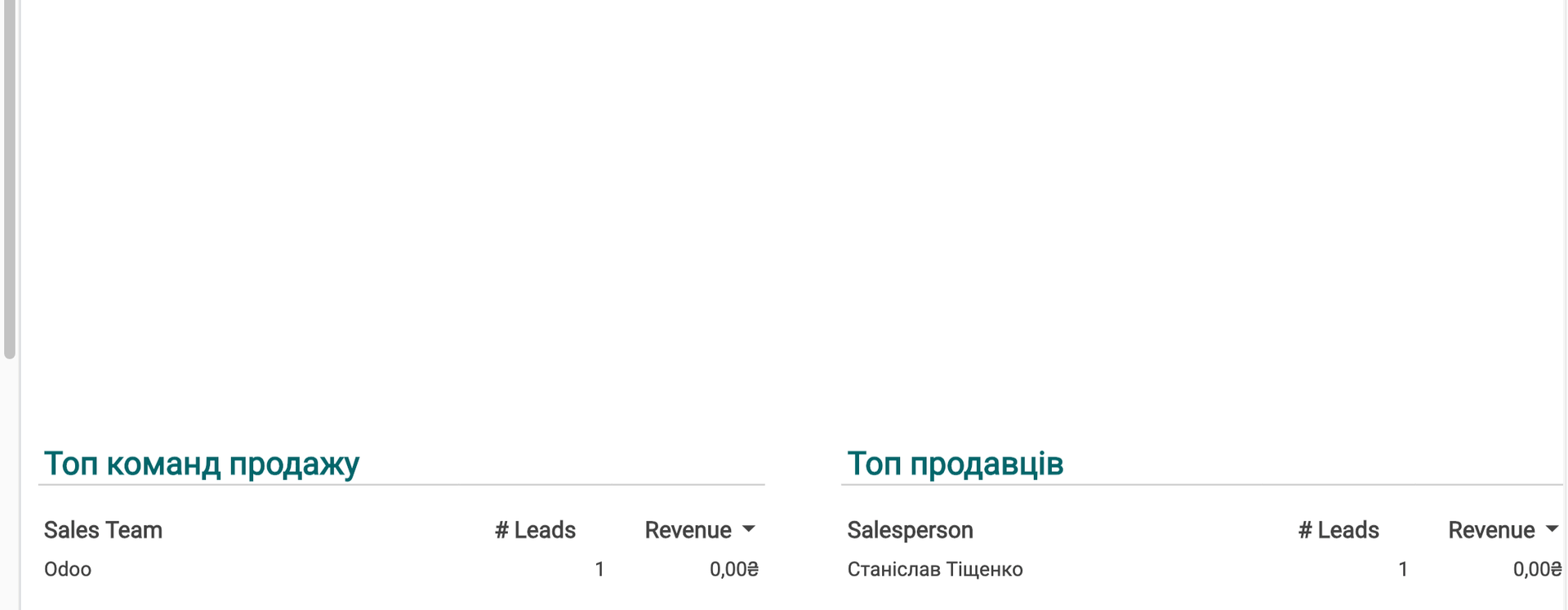
The "Top Tags" dashboard instantly highlights which specific business niches bring us the most clients. When a sales representative processes a lead, they immediately add a color tag to the card based on the client's area of activity (for example: Manufacturing, Miltech).
And this is already a direct benefit for marketing: instead of a blanket mailing, I can make a targeted, segmented offer for a specific niche — and see which segments respond to the advertising at all. This is no longer abstract guesses, but a ready hint for the marketing strategy for the coming weeks.
I see this data every day in real time:
If we had analyzed the market using old methods and learned about a surge of interest in the e-commerce or manufacturing niche only from a quarterly report — it would have been too late to react. With Odoo, we instantly reallocated part of the advertising budget and adjusted the content to current requests within a week.
The framework scales according to the size of the team: a small business needs just a basic connection between the website, CRM, and mailing, while a large company requires a complete dashboard with attribution across all campaigns.
Data is transferred during implementation; the complexity depends on how structured your current sources are.
No. Both modules are part of one Odoo, so the setup is done in a shared administrative window, without separate integrators for each system.
Odoo is a powerful ecosystem, not just a "box" application. Everything works only when the system is configured to your business processes. Transitioning to Odoo is a project that requires time: from the analysis of business processes to setting up integrations and training the team. Our experience shows that the investment of time during the implementation phase pays off with stable and coordinated work from the marketing department in the future.
The standard functionality of Odoo covers 80-90% of the needs of most companies. However, if your business has specific requirements, complex multi-level funnels, or a unique data architecture, we perform customization. Odoo is a flexible open-source platform that allows you to add any functionality, integrate third-party services, or create your own modules for the most ambitious tasks.
An honest report on lost deals
The most useful report for me as a marketer is not about victories, but about why customers refuse services. The dashboard 'Top Reasons for Loss' shows the reality without embellishments.
What does this say to the marketer? A large number of refusals due to "not relevant" is a direct signal that our targeting is missing the mark. The traffic attracted people for whom business automation is simply not timely at this stage.
Seeing this statistics on the dashboard immediately, we quickly adjust the audience settings in Meta and review the keywords in Google Ads. We cut off non-target traffic and focus exclusively on the hot audience that is looking for an ERP system here and now.
What makes this work?
Behind each number is a specific built-in Odoo tool, not an abstract wonder:
Module | What he does for marketing |
UTM Tracking | Captures the source of traffic (campaign, source, medium) in the lead card |
CRM Dashboards | Consolidates all data across sales channels and KPIs into one screen |
Marketing Automation | Launches automated email chains for those who are still "thinking" |
Automated Actions | Automatically generates weekly reports with numbers |
This covers most of the routine that used to take me a whole day: from calculating the cost of leads by channels to smart segmentation of the database.
Our marketing has stopped being a "black hole for money" that the CFO looks at with suspicion. Automation in Odoo has made it a transparent profit driver, where the return on every invested hryvnia is clearly visible.
If you are tired of chaos, Excel spreadsheets, and dozens of open tabs —
order a free Odoo demonstration for marketing— we will show how this will work specifically for your tasks and data