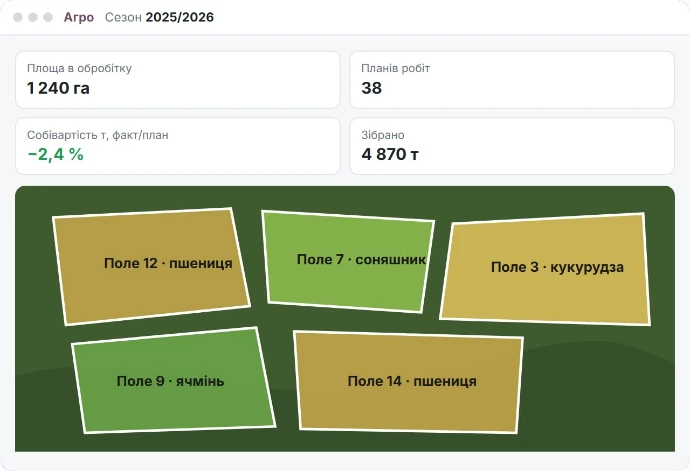
Odoo ERP for Agribusiness: Land Accounting and Cost per Hectare
Agribusiness system on Odoo: from the field outline on the map and lease agreement to the technological map, field operations, inventory, logistics, and field closure with actual cost. No separate tables and double entry.
Odoo ERP capabilities: the program for agribusiness covers the entire farm cycle
Field accounting and land map in Odoo
Fields, plots, and land map
All the land of the farm is in one structure: a field is divided into plots, a greenhouse into blocks, rows, and cells, an orchard into rows. Types of places are configured without a programmer, and the system ensures that the nesting remains logical.
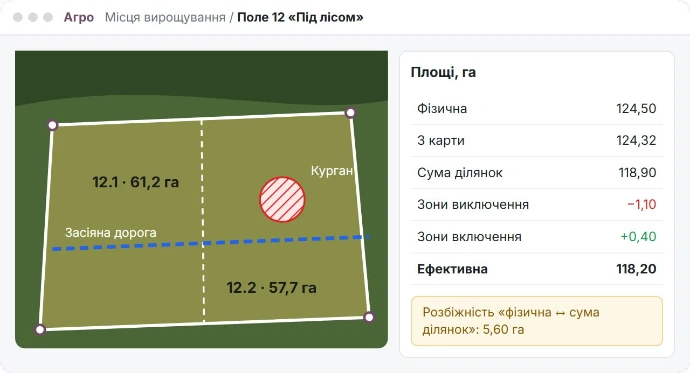
The outlines of fields, plots, and zones are drawn with a mouse directly on the satellite map, and the area is calculated from the coordinates immediately. Turning points of boundaries can also be entered via a table — in WGS84 or UTM-2000.
The area no longer "drifts".The system shows the physical area, the area from the map, the sum of plots, and the effective area — and highlights discrepancies between them. A mound, a power line support, or a tree belt is subtracted by the exclusion zone, while a plowed and sown field road is added by the inclusion zone.
If the field is replanned, old plots go to the archive but remain in the history and analytics of past seasons.
Accounting for shares and land lease
Land bank and lease of shares
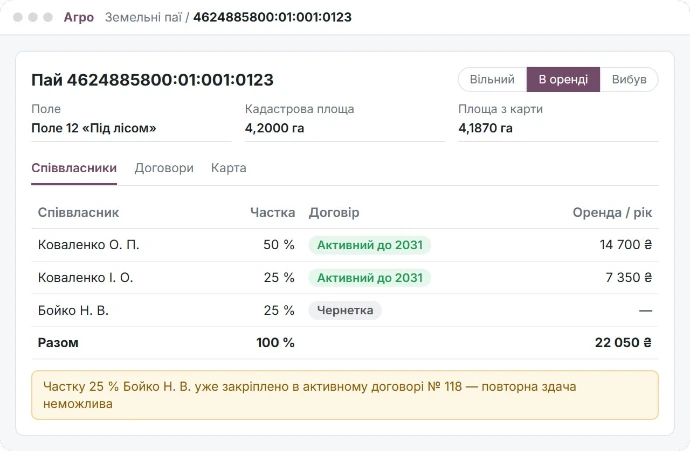
The land bank is maintained as a separate layer from the production structure. The share has a cadastral number with format and uniqueness verification, a contour on the map, area, and a list of co-owners with their shares. The re-planning of plots does not affect the legal attachment of the share to the field.
Lease agreements are protected from typical errors:a share cannot be leased twice, the sum of shares will not exceed 100% of the share, and a contract with history will not disappear due to accidental deletion.
The annual rental value is calculated proportionally to the days of the contract's validity in the year, and the summary of rental obligations is available by years and by owners.
The main thing is —the rent automatically becomes part of the cost of the crop on the plot, rather than remaining a separate file in accounting.
Technological maps and season planning
Crops, soils, and crop rotation
Crops, varieties and hybrids, seed reproductions, and harvest classes are linked to warehouse goods once. After that, seeds, main and by-products are automatically inserted into documents.
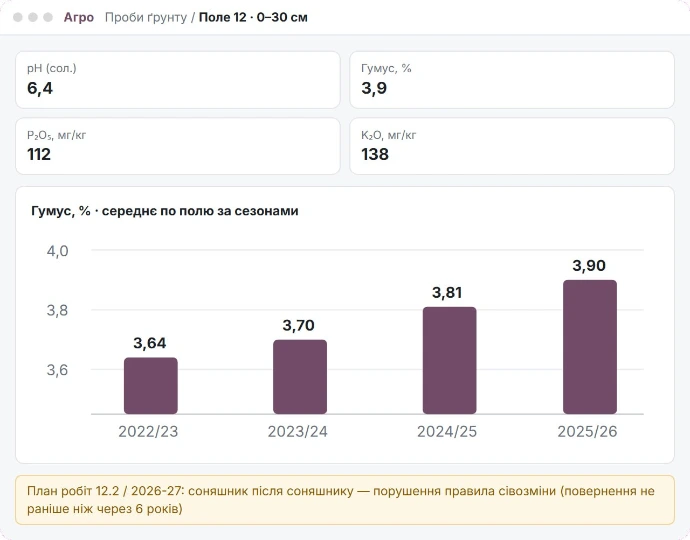
Soil samples — pH, NPK, humus — are taken at different depths and seasons, with a marked sampling location on the field map. Average values across the field, summaries, and graphs show how fertility changes from season to season.
Crop rotation is monitored even at the planning stage.Rules are set in the crop card, the history of sowings for each plot is always at hand, and if the plan violates crop rotation — the system will warn before its approval.
Seasons are tracked according to the agricultural year — from October to September.
Accounting for field work, equipment, and fuel
Technological maps and season plan
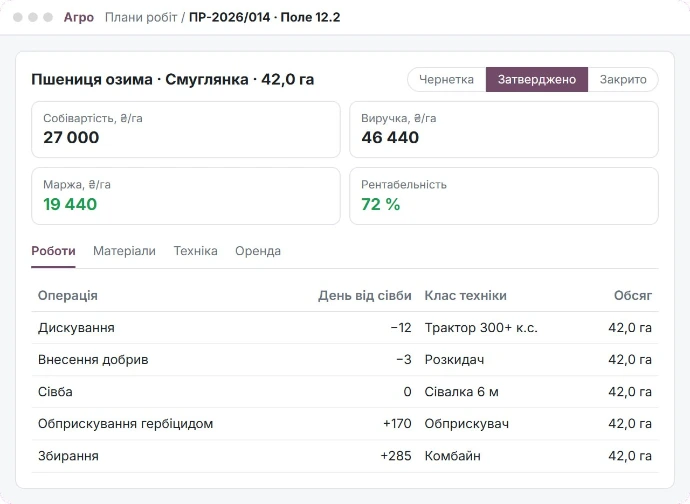
The system already has51 ready agro-operation— from tilling to harvesting — with production norms, fuel consumption, pricing, and equipment class. Norms are set once for the farm and then apply to all documents.
The technological map of the crop describes materials, work, and equipment in the calendar from the sowing date, planned yield, variety, and by-products.The economics of the crop can be seen even before the season:planned cost price, margin, and profitability per hectare. The tech map can be printed — either regular or with profitability.
The work plan for a specific plot is created from the tech map in a minute and recalculated for the actual area and sowing date. The budget for the plot includes materials, equipment, labor, and land rent. Before approval, the system checks the crop rotation, season boundaries, and area, and the approved plan becomes the basis for control.
If the crops fail, re-sowing is processed according to Methodical Recommendations No. 132: costs are automatically distributed between losses and the cost of the new sowing.
Execution
Field work: tasks and accounting sheets
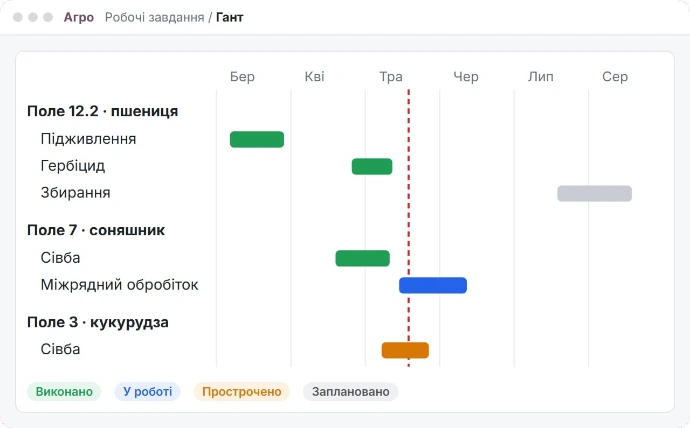
After the plan is approvedwork tasks are created automatically— with responsible persons, dates, materials, and equipment class. Work for the period is launched with one click, and the Gantt chart shows the workload by fields and plots with color coding by status.
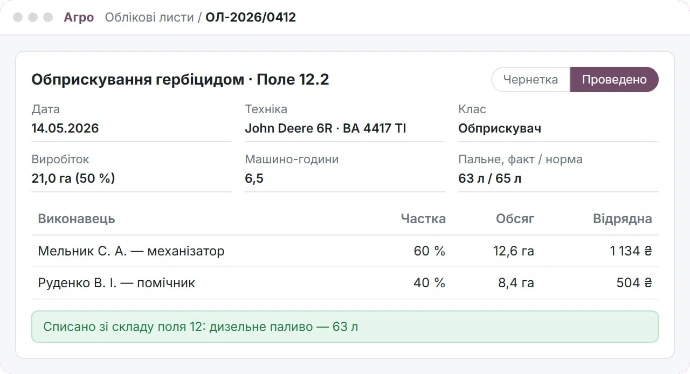
The fact is recorded in daily accounting sheets: date, equipment, performers, output in hectares or percentages, machine hours, and fuel. The volume is divided among the performers, andpiecework paymentis calculated by people, work, and periods — without Excel.
When closing the task, the system reconciles issued, entered, and remaining: the remainder is returned to the warehouse or left in the field, and the replacement of the product is recorded and visible in the report.
Technique
Equipment and fuel
Register of equipment with classes and rates for machine hours. One machine can belong to several classes — for example, a tractor works both in plowing and in fertilizing.
In the plan, the cost of equipment work is calculated automatically by class, while in reality, the specific machine, its hours, and fuel are visible.
Fuel is planned according to the norms of agricultural operations and is deducted from the stock based on actual work.Without stock remaining, the accounting sheet will not be processed — there will be no 'paper' fuel in the accounting.
Logistics
Delivery 'warehouse ↔ field'
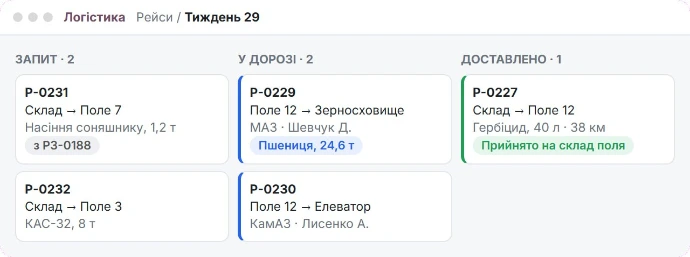
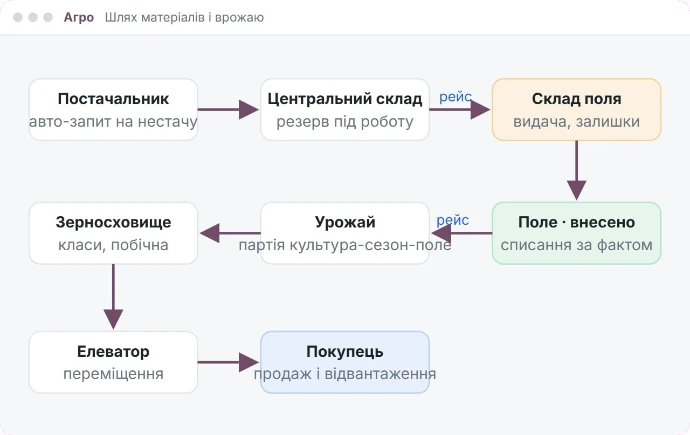
Materials to the field and harvest from the field are transported in trips.A request for a trip is created from a work task or warehouse document, the dispatcher assigns transport and a driver, and calendars show who is busy and when.
The trip is related to warehouse movements in Agro: seeds, plant protection products, and fertilizers arrive at the field warehouse, and the harvest departs from the field to the grain storage or elevator. The mileage and fuel of the trip are recorded.
The manager sees the entire chain in one place: what has been ordered, what is on the way, what has already arrived.
Warehouse
Warehouse, purchases, and harvest
A warehouse is automatically created for each field.Materials are reserved for work in advance— one week before the start, and the storekeeper issues them to the field. Stocks do not get lost between the central warehouse and application.
A shortage of seeds, plant protection products, fertilizers, or fuel automatically becomes a request to the supplier— the manager only needs to check and send. Then the usual procurement process in Odoo works: comparing offers, acceptance, batches, and expiration dates.
The harvest is accounted for by classes along with by-products, in batches of 'crop - season - field', so it is known from which field each ton comes. The yield is calculated from the harvested area and compared to the planned.
Next, the grain is moved to its own grain storage or to an elevator and is sold and shipped to the buyer through the standard Odoo sales process.
Economics
Plan/Fact and Field Closure
Each expense — materials, labor, equipment, rent —is automatically assigned to the analytics 'plot - crop - season', without manual tagging.
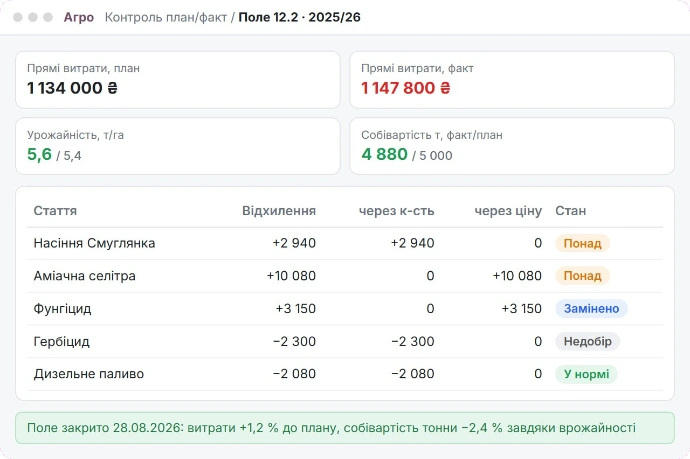
The control report compares the approved plan with the actual across the entire chain and breaks down deviations into two factors:too much was applied or it was bought at a higher price. Each line has a clear status: normal, above plan, shortfall, sorting, replaced, without fact.
At the end of the season, the field is closed: the system collects all direct costs — labor and materials — and shows the result of the plot: actual costs per hectare and per ton of harvest against the plan.
The manager receives an answer to the main question of the season —how much this hectare cost and why exactly that much— not six months later in an economist's file, but immediately after harvesting.
Questions and Answers
The solution is suitable for arable, greenhouse, horticultural, and vegetable farms, as well as medium-sized agricultural enterprises. The land structure is customized for your type of farm: the field is divided into plots, the greenhouse into blocks and rows, the orchard into rows. You can start with part of the processes, for example, with fields and storage, and connect the rest gradually.
So. We are transferring fields, shares, lease agreements, and crop history into the Odoo structure, while consolidating land accounting, inventory, work, and cost per hectare into one system instead of 1C and separate Excel tables. The transition occurs without stopping the business, and we are training the team to work with their own data. Read more about the process on the page міграції з 1С на Odoo.
The cost is formed from three sources. Before the season - from the technological map and the work plan of the plot (materials, equipment, labor, lease of shares). During the season - from accounting sheets and write-offs from the warehouse, which automatically fall into the analytics "plot - crop - season". After harvesting, the field is closed, and the system shows the actual direct costs per hectare and per ton of harvest against the plan, with a breakdown of deviations by quantity and price.
A share is maintained with a cadastral number, contour, area, and co-owners with their shares. A lease agreement is made for each share; the system will not allow a share to be leased twice or exceed 100% of the share. The annual lease cost is calculated based on the days of the contract's validity, and in the work plan of the plot, the lease is a separate expense item and then enters the cost of the crop.
Yes, the structure of growing places provides for this: a greenhouse is divided into blocks, rows, and cells, an orchard and vineyard into rows, and each level can be a separate accounting object. Specific functions for these areas, such as accounting for perennial crops or multiple crop rotations per season, are developed according to the product roadmap.
No, and this is a conscious decision. Agro is responsible for management accounting: land, agronomy, work plan and fact, inventory, logistics, and cost. Accounting and tax records, payroll, and payments to shareholders remain in the farm's accounting system.
Yes. Field, share, crop, and variety reference guides are loaded from tables, the history of sowing by plots is imported for crop rotation control, and field boundaries can be drawn on the map or transferred from the coordinates of turning points.
Each field has its own warehouse. Materials are reserved for a specific job, issued by the warehouse manager to the field warehouse, and are only written off upon actual application in the accounting sheet. When closing a task, the system reconciles the issued, applied, and remaining: the remainder is returned to the warehouse or remains in the field and is visible in the inventory.
How implementation occurs
ERP foragricultural company
1
Process analysis
We analyze the structure of land, crops, equipment, and how accounting is currently conducted: Excel, 1C, or paper journals.
2
Structure setup
We create fields, plots, types of locations, crops, and classes of equipment. We connect 51 ready-made agro-operations with norms and rates and adjust them to your farm.
3
Перенесення даних
We import fields, boundaries, shares, and lease agreements.
4
Technological maps and season plan
- We set up crop tech cards and create work plans for the plots. The planned cost per hectare is immediately visible.
5
Team training
Agronomists, warehouse managers, dispatchers, and economists receive practical training on their data.
6
Launch
We start with the necessary processes (for example, fields, warehouse, and accounting sheets), and connect the rest step by step, without stopping work. Then technical support follows.
Ready to automate your farm?
Leave a request, and our experts will contact you for a free consultation and demonstration of Agro on Odoo.
📞 +380638452951 · ✉️ info@ubmsoft.com.ua